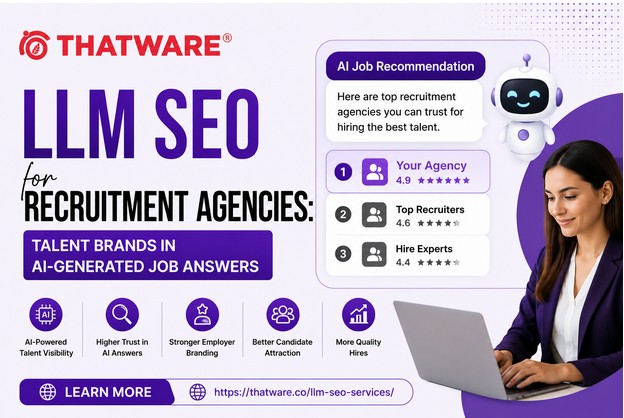
Recruitment agencies operate in a market where trust is everything and differentiation is genuinely hard. Candidates and clients alike are deciding who to work with based on reputation, specialization, and perceived quality — and increasingly, those initial impressions are being formed through AI-mediated research. When a job seeker asks an AI assistant “what are the best recruitment agencies for tech roles in [city]?” or a hiring manager asks “which staffing firms specialize in [niche]?”, the agencies that appear have a significant advantage in a highly competitive market.
The Dual Audience Challenge
Recruitment agencies face a distinct challenge in LLM SEO: they have two audiences with fundamentally different needs and research behaviors. Candidates are looking for help landing the right role — they want guidance, information, and advocates. Clients are looking for a reliable talent sourcing partner — they want proof of specialization, track record, and operational credibility.
Building LLM visibility requires content and authority signals that speak to both audiences simultaneously, while also being organized so that AI systems can correctly categorize the agency’s expertise relative to each query type. An agency that appears strongly for candidate-facing queries but weakly for client-facing queries (or vice versa) has an imbalanced LLM presence that limits its overall commercial impact.
Specialization as the Core LLM SEO Asset
In recruitment, specialization is the primary differentiator — and it’s also the primary LLM SEO asset. A generalist recruiter competing with a specialized firm for LLM citations in tech hiring, legal placements, or healthcare staffing will almost always lose. Language models favor sources that have demonstrated deep, consistent expertise in a defined area.
This means that recruitment agencies with genuine specialization should build their LLM content strategy aggressively around that specialization — going deep on industry-specific hiring trends, candidate market dynamics, compensation benchmarks, and skills evolution. That depth is what makes the agency genuinely citable as an expert source when AI models answer questions in their specialist domain.
Leveraging professional LLM SEO services for brands that understand the nuances of talent industry positioning can accelerate this specialization-anchored visibility building significantly.
Thought Leadership Content for Recruitment LLM SEO
The content types that build LLM citation share for recruitment agencies are those that demonstrate genuine market knowledge: salary and compensation reports (original data is particularly valuable), hiring trend analysis, candidate experience research, skills and workforce evolution content, and expert commentary on labor market dynamics.
This content positions the agency as an authoritative voice on talent market topics — not just as a service provider. That positioning is what earns AI citations in the research queries that candidates and hiring managers conduct before deciding who to work with.
B2B SaaS Parallels
There are meaningful parallels between recruitment agency LLM SEO and the patterns that work well in LLM SEO services for B2B SaaS — specifically, the emphasis on category authority, third-party credibility signals, and the importance of appearing in evaluation-stage research queries. Hiring managers evaluating recruitment partners behave similarly to software buyers: they research extensively, they check multiple sources, and they’re looking for evidence of credibility before engaging.
The agencies that invest in the same types of authority-building content and third-party presence that work for SaaS vendors — industry publication presence, case study content, analyst recognition, review platform presence — tend to build the most durable LLM visibility in their markets.
Measurement for Recruitment LLM SEO
Tracking the LLM visibility impact for recruitment agencies means monitoring queries in both the candidate and client tracks. For candidate queries, this includes searches about agency reputation, specialization, and placement process. For client queries, it includes searches about staffing partners, hiring support, and talent sourcing in specific domains. Both tracks matter, and the measurement program should track both.
Starting Point
For most recruitment agencies, the LLM SEO starting point is a visibility audit that maps where the agency currently appears (or doesn’t) across its most important query categories. That baseline reveals the highest-leverage investment opportunities and provides a benchmark against which progress can be measured over time.